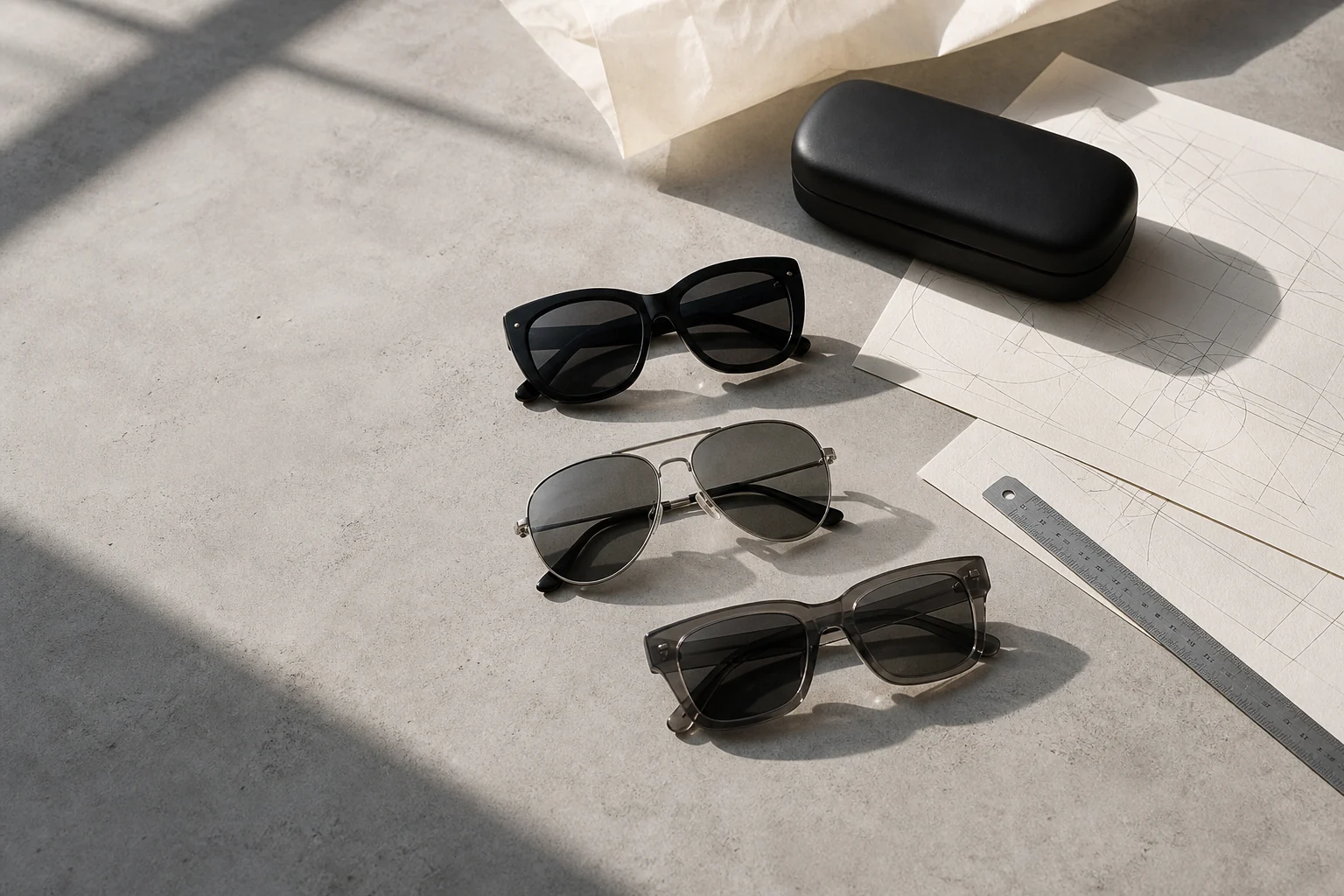
Choose the sample plan around one decision.
The scenarios below illustrate a 5-piece opening brief. Each depends on written approval of model and color allocation; none is a promise that arbitrary mixing is available.
| Question | Illustrative allocation | What you learn | What stays unknown |
|---|---|---|---|
| Which shapes suit the assortment? | Five models × one pair | Compare outlines, finish and fit directions. | Consistency across multiple pairs of the same model. |
| Are the main candidates consistent? | Two + two + one across three models | Compare two pairs for each main candidate. | Statistical quality of a future production batch. |
| Is one reference worth taking forward? | One model × five pairs | Inspect repeated units of one confirmed version. | Demand for other shapes or colorways. |
Put a ceiling on the whole sample spend.
Work from the money at risk before the first resale. An illustrative ten-pair order at US$45 per pair is US$450 in goods. Adding US$30 freight and US$20 import charges produces US$500, or US$50 per pair. These are teaching inputs, not a KUANGTU offer or a destination-specific tax estimate. A different delivery term may already include some charges.
Use the order budget calculator with your written quote. Confirm the term, named place, insurance, clearance charges and exclusions. Keep sample preparation separate from carrier transit and customs time.
Send a brief the supplier can answer line by line.
Use the downloadable sheet to specify the reference, preferred color, quantity, decision being tested and evidence needed. Include your destination and requested timing in the enquiry. Ask the supplier to mark unavailable combinations and propose substitutions as separate rows.
Download the sample planBefore approving a repeat order, keep the approved pair’s photos, markings, packaging and quote version. Record what changed between sample and bulk offer; a sample approval should not silently approve a substitute.
Define how the MOQ is allocated
Ask whether the quoted minimum applies to one model, one colorway, one design house, or the combined order. Put the allocation beside every reference in the quote. A total quantity without a model-level allocation is not sufficient for approval.
Separate sample facts from regular-order facts
KUANGTU normally targets 1–3 days for sample preparation and 3–5 days for regular-order preparation after payment and written confirmation. These are preparation targets, not delivery promises; stock, packaging, destination, and shipping route can change the total timeline.
Use the sample as an approval record
Record the model and colorway, photograph the front and temples, note the measurements, inspect the hinge and lens condition, and retain the approved packaging details. Link those observations to the written quote so a repeat order has a concrete comparison point.
Compare landed decisions, not unit prices alone
A smaller order can have a different freight cost per piece. Compare the product tier, packaging, shipping basis, payment terms, and destination charges together. Ask what is included and who is responsible at each stage before selecting the quote.
Design the sample order to answer decisions
Do not use limited quantity to collect near-duplicate styles. Select samples that test different shapes, materials or construction, fit groups, lens descriptions, and price bands relevant to the intended customer. Write the question each sample must answer, such as whether a bridge fits the target customer or whether a package protects a rimless design. The result should narrow the opening order, not merely enlarge the sample drawer.
Set a stop or proceed gate
Before sampling, define what must be confirmed before a regular order can proceed: model identity, accepted visible quality, measurements, package, price tier, quantity allocation, preparation target, and delivery basis. Record acceptable changes and points that require a new sample. A low-MOQ purchase should still stop when critical facts remain unknown or when the physical sample cannot be matched to the written quote.
Working table
Sample-to-order decision gate
| Gate | Evidence | Decision |
|---|---|---|
| Model | Reference and colorway match the quote | Proceed or correct the record |
| Product | Measurements and observable condition are accepted | Approve, revise, or reject |
| Package | Contents and protection match the requirement | Confirm cost and carton basis |
| Commercial | MOQ allocation, timing, payment, and delivery are written | Authorize only the agreed version |
Buyer checklist
Save these checks with the order record.
- Give every sample a decision purpose.
- Record the model and colorway on arrival.
- Photograph visible condition and package.
- Separate preparation time from transit.
- Approve the final regular-order version in writing.
Buyer workflow
A documented path from shortlist to order.
- 01
Shortlist
Choose exact models and colorways, then state the estimated quantity for each.
- 02
Quote
Confirm MOQ allocation, price tiers, stock, packaging, preparation target, and delivery basis in writing.
- 03
Sample
Approve the physical reference and record its condition, measurements, and package.
- 04
Order
Match the final order and future repeats to the approved reference and written terms.
Quick answers
What is KUANGTU's opening wholesale MOQ?
Wholesale enquiries start from 5 pieces, subject to model availability and the allocation stated in the written quote.
Does sample preparation time include shipping?
No. Preparation and transit are different stages. The destination, carrier or shipping line, service level, customs handling, and delivery basis affect transit time.
Can different models be mixed in one order?
The requested mix should be listed in the buying brief. Whether quantities can be allocated across models or colorways must be confirmed in the written quotation.
Should the cheapest sample determine the opening order?
No. Compare its relevance to the target customer, model data, condition, package, commercial terms, and repeat-order usefulness alongside price.
When should a buyer request a new sample?
Request one when the model, colorway, construction, package, or another material specification changes beyond the accepted approval record.
Sources and scope
This buying guide draws on the company’s supplied order information, supplier catalogue records and written quotation conditions. It is guidance for preparing questions, not a report of product testing or a customer case study.
Public sources reviewed 2026-09-11. Reference specifications and general guidance do not certify the offered goods.
- International Chamber of Commerce — Incoterms® 2020
Explains the allocation of costs, risks and obligations in international trade. A trade term does not supply a freight price or tax rate.