
Read the marks, then measure what is missing.
In a marking such as 52 □ 22 — 145, the values describe one lens, the bridge and the temple respectively, in millimetres. Do not calculate total outside width as 52 + 52 + 22: that omits the rims and endpieces. FramesDirect also distinguishes hinge-to-hinge sizing from the lens size printed on a temple.
Three public cross-checks, three different outcomes.
We compared the supplier records with published brand or retailer pages on 2026-09-11. This desk review checks what the records say; it is not a physical inspection.
Listed dimensions agree
FT1327
The brand page lists 52–22–145, matching the three dimensions in this supplier record. This is a reference match, not verification of the supplied pair.
Brand page: black, size 52; product number 0200760023015.
Next check: Request a current photo of the model and color code inside the temple, plus the actual pair’s front width and packaging. Match those to the written quote.
TOM FORD — Icon Rectangular Sunglasses FT1327 →Size and shape need clarification
SLM160
This supplier record lists 47–25–145 and a cat-eye shape. The retailer page lists 53–19–145 and a rectangular shape. These records cannot be treated as the same confirmed specification.
Retailer page: SL M160; 001 Black and 003 Havana options; described as a narrow rectangular frame.
Next check: Ask for the full temple marking, including any suffix, a straight front photo and a ruler measurement. Resolve the model and size difference before approving a sample.
Select Eyewear — Saint Laurent SL M160 →Temple length needs clarification
Enzo 10th
The supplier record is 51–23–150. The retailer’s Breccia Decade listing is 51–23–144: lens and bridge values agree, but temple length differs by 6 mm. Colorways and editions must be matched before interpreting that difference.
Retailer page: Enzo, Breccia colorway, Decade Collection. Its specifications apply to that listed version.
Next check: Confirm the edition and color code, the temple marking and how the temple was measured. Do not transfer lens materials or performance claims from the retailer’s version to the quoted pair.
SM16 — Enzo, Breccia, Decade Collection →A measurement record another buyer can reproduce
- Photograph the full model, color and size markings before measuring. Keep edition and suffix information.
- Place the frame without forcing it open. Record front width outside-to-outside with a millimetre ruler; label a hinge-to-hinge measurement separately.
- Record the maximum horizontal lens width and vertical lens height using the same endpoints for every pair. Keep ruler photos square to the frame to reduce perspective error.
- For temple length, keep the printed value and a separate measurement along the arm. Record the method at the bend; a straight chord is not equivalent.
- Record weight in grams with the empty scale zeroed, without case or packaging. Save the reading, date and photo against that exact sample.
A published size difference is a reason to reconcile the record, not proof of a defect. Agree tolerances and the measurement method before judging a sample.
Compare supplied model dimensions →Read the three core measurements
A notation such as 54□20—145 usually means a 54 mm lens width, a 20 mm bridge, and a 145 mm temple. Some shield and rimless designs use different conventions, so confirm the supplier’s measurement method when the notation is incomplete.
Treat shape and width together
Two frames with the same lens width can fit differently because of bridge construction, lens depth, end-piece position, and overall frame width. Compare the full front view and side view alongside the written measurements.
Build an assortment across proportions
A retail buy is more useful when it covers compact, standard, and wider fits instead of repeating one proportion. Track total frame width where available, then group the assortment by silhouette and likely fit rather than relying on gender labels alone.
Publish measurements consistently
Use the same field order on every product page and state when a measurement still needs confirmation. Consistent product data reduces pre-sale questions and gives search engines and AI answer systems clearer facts to retrieve.
Translate measurements into retail fit groups
Create internal fit groups such as compact, standard, and wide only after reviewing your own product data. A group should combine total front width with bridge design, lens depth, and temple spread. Do not publish a universal face-size promise from lens width alone. Instead, show the measurements you can verify, add a plain-language fit note based on the sample, and explain when a number is unavailable. This is more useful for buyers and more defensible than a vague small, medium, or large tag.
Audit measurement consistency before upload
Check that every record uses millimetres, the same field order, and a stated source. If a supplier notation is ambiguous, preserve the source image and mark the field for confirmation. Do not convert a product photograph into a precise measurement unless the image contains a reliable scale. For repeat orders, compare the delivered sample with the approved measurement record and document any tolerance that was agreed in the purchase specification.
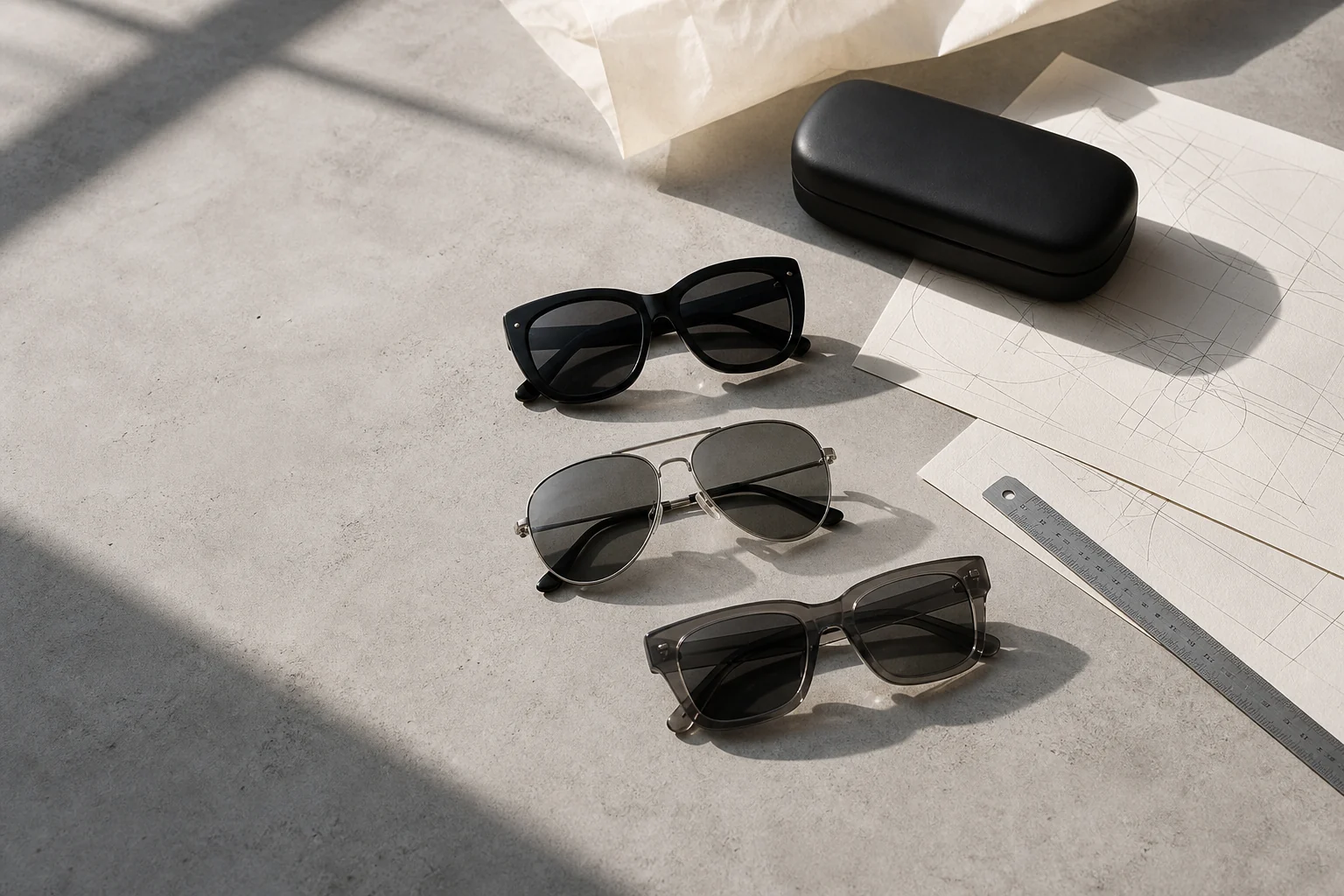

Working table
Frame measurement and fit reference
| Field | What it describes | Buyer caution |
|---|---|---|
| Lens width | One lens at its widest horizontal point | Does not equal total frame width |
| Bridge width | Distance or stated bridge size between lenses | Construction changes how the number fits |
| Temple length | Length of the temple stated by the supplier | Bend position and frame angle still matter |
| Total front width | Outer width of the complete front | Method and measurement point should be consistent |
Buyer checklist
Save these checks with the order record.
- Use millimetres and one field order.
- Keep source images with transcribed sizes.
- Compare full front and side views.
- Add lens depth and total width when available.
- Mark unknown or unverified measurements for confirmation.
Buyer workflow
A documented path from shortlist to order.
- 01
Shortlist
Record the exact model references, colorways, quantities, destination, and required timing.
- 02
Confirm
Request current availability, price tiers, packaging, preparation time, shipping basis, and supporting documents in writing.
- 03
Approve
Compare the sample and written terms with the intended market requirements before payment.
- 04
Record
Keep the approved reference, photos, measurements, packaging, and commercial terms for repeat-order control.
Quick answers
What does 54□20—145 mean?
It normally indicates 54 mm lens width, 20 mm bridge width, and 145 mm temple length.
Is lens width the same as total frame width?
No. Lens width measures one lens. Total frame width also includes the bridge, rims, hinges, and end pieces.
Can two 54 mm frames fit differently?
Yes. Bridge design, lens depth, curvature, end-piece position, and overall width can make the fit noticeably different.
Should retailers publish small, medium, and large frame labels?
Only when the store defines those groups from consistent measurements and explains the method. The verified numeric fields should remain visible.
Can frame size be measured accurately from a product photo?
Not without a reliable scale and controlled perspective. Use supplier specifications or direct physical measurement, then record the source.
Sources and scope
This buying guide draws on the company’s supplied order information, supplier catalogue records and written quotation conditions. It is guidance for preparing questions, not a report of product testing or a customer case study.
Public sources reviewed 2026-09-11. Reference specifications and general guidance do not certify the offered goods.
- FramesDirect — Ray-Ban sizing guide
Explains lens, bridge and temple measurements, and distinguishes hinge-to-hinge width from lens size.
- TOM FORD — Icon Rectangular Sunglasses FT1327
Published reference specifications only; see the version and discrepancy notes in the comparison.
- Select Eyewear — Saint Laurent SL M160
Published reference specifications only; see the version and discrepancy notes in the comparison.
- SM16 — Enzo, Breccia, Decade Collection
Published reference specifications only; see the version and discrepancy notes in the comparison.